

AMAZON FINTECH
OMNIA
1 Designer
12+ Months
Amazon is known for its sheer scale. What's more impressive than automating the tax compliance process for a whole country? Yep, automating it for the entire world. After the my experience with T-Rail, I was tasked with designing for Amazon FinTech's most ambitious project yet — Omnia, an end-to-end cloud-based solution to simplify and automate indirect tax reporting compliance for all Amazon businesses outside the US.
The scope of Omnia overshadows all my previous projects. Not only will the tool support 65 countries with more than 12 types of tax obligation, it will also cover the entire tax compliance cycle — starting from maintaining billions of dollars' worth of accounting data, all the way to filing tax returns directly with the various government tax authorities, and keeping an audit trail for everything in between. This is certainly no easy task, and development is estimated to take multiple years. However, this million-dollar project is considered a strategic investment by Amazon's Finance and Global Business Services. After full launch, this single tool will save Amazon's tax teams over 200,000 manual hours every year, a 78% reduction from current manual processes. No third-party enterprise products can support Amazon's immense business scale, so we will build it ourselves.
RESEARCH
用戸研究
Personas
After two years at Amazon FinTech, by this point I was more or less a subject-matter expert in tax user experience. With my knowledge of the existing tax compliance journey, creating personas was no issue. The UX team provided templates that were easily reusable, and previous PMs had already completed early user research. After checking with key custom stakeholders, I quickly moved on to the next steps.


Journey Maps
Producing the full journey map, however, was another story. Unlike previous projects that usually focused on a specific stage of the tax compliance process, now I had to construct a truly end-to-end journey: building and maintaining data repositories, reviewing and adjusting transactions, preparing reports, reconciling tax amounts, filing tax returns, and creating a clear audit trail. Also, throughout all this, different steps are accomplished by different personas. I carefully labelled out each task by user persona, so folks could better visualize the complex relationships.
To better illustrate Omnia's impact, I also created a future version of the journey map after confirming the business requirements. Now stakeholders can clearly see which steps will be simplified and how many painpoints will be eliminated. Having such a before-and-after view really made the promised values of this massive project much more grounded. Instead of the grandiose but nebulous ROI figures, tax users could now look at the journey map to see how they will be affected.
Competitive Analysis
This is not something one often get to say, but third-party fintech providers like PwC and Thompson Reuters simply could not meet our demands. The sheer size and complexity of Amazon's business meant we had a truly one-of-a-kind design problem on our hands. Nonetheless, these industry-leading providers and their enterprise tax solutions still offered us much to learn. By reviewing the product team's marketplace analysis, I could see where each tool succeeded and where they fell short, thus gaining a better idea of what was needed for Omnia.

IDEATION
設計構想
Functional Requirements
To get started with ideating a system as enormous as Omnia, I organized a series of brainstorm sessions with PMs and engineering leads to come up with key functionalities needed to accomplish the business goal. We started with an affinity diagram of sticky notes. Later on, by referencing the journey map, we played around and tried to align them into a logical flow. Essentially, we were developing a new standard operating procedure.

User Flow
As the functional flow was beginning to take shape, I began drawing out the user flow diagram. The journey map painted the overall picture from an operational perspective, across multiple user personas and tools; now I had to get into each persona's shoes and delineate their individual workflows while envisioning a singular product. As different users perform different tasks throughout the journey, it is important to mark out how they interact with one another, so to ensure a streamlined flow that feels natural for everyone.

Information Architecture
With both the functional requirements and user flow clarified, I could lay out the outlines of an application. The platform would be broken down into multiple silos, or modules, that roughly correspond to major steps of the tax compliance journey. Information hierarchy is organized in a way that make sense for the different user personas — some personas only perform tasks within one module, while others need to navigate across multiple modules as they move along the tax process. At the same time, a modular approach enables the engineering team to build functional components using micro-frontends, ensuring reusability and consistent UI for different tax obligations.


Screen Flow
Only after the information architecture had been approved did I finally begin to develop the actual screens. At Amazon, my tried-and-tested method is to first draft a UI screen flow before moving on to prototyping. The powerful Cloudscape Design System from AWS allows me to plop in ready-made screen thumbnails and quickly build out an overview of the entire UI.
This paints an even clearer picture of what exactly we would be building, so the various stakeholders can all give their feedback and sign-offs before I jump into detailed mockups. While there will always be iterations, I also want to ensure team alignment early on to reduce wasteful back-and-forth as much as possible. For a project as complex as Omnia, this is especially important, as the prototyping process will surely be convoluted enough.
PROTOTYPE
原型制作
Hi-fidelity Mockups
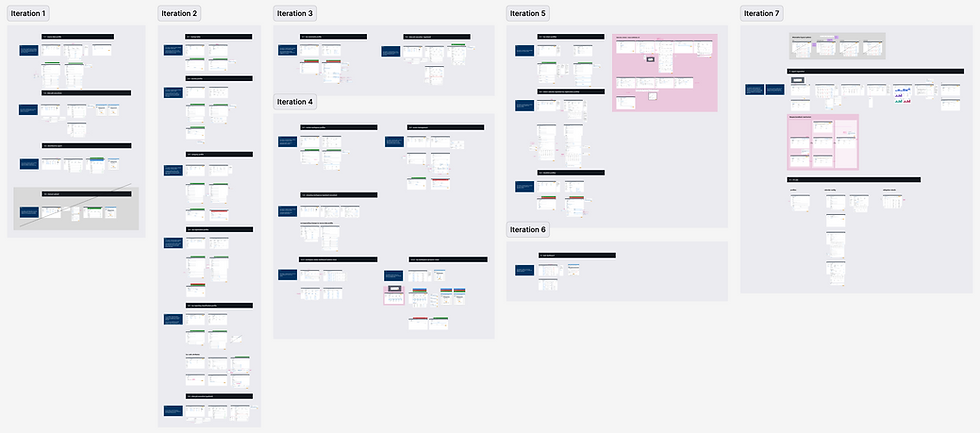
By this point in my career, crafting polished UI in Figma already comes naturally. Nonetheless, the sheer scope and technical complexity of the app still proved challenging. To create such an enterprise system from the ground up, one must have a clear roadmap. I actively co-ordinated with the PM to break down feature deliveries by iteration, starting from the most basic components of admin configuration and gradually developed the interfaces for the other personas. Throughout the entire process, I communicated weekly with the engineering team in Amsterdam and business stakeholders in London, making sure the whole team is aligned on each new design deliverable, so to avoid future issues as much as possible.
Usability Testing
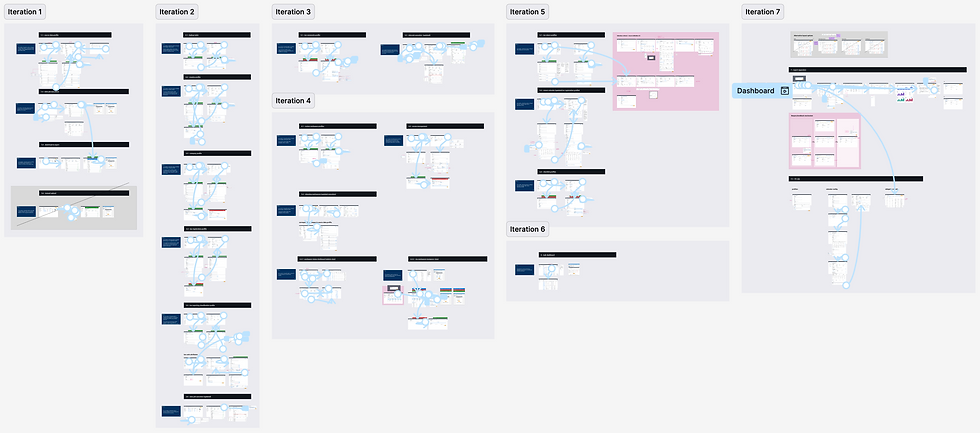
Of course, there is always bound to be issues, especially for a project of such size and scope. As I handed off one screen design after another, I began to realize our modular approach was perhaps too modular — each micro-frontend was focusing on one user task and entirely separated from each other, and end up feeling like a suite of disparate apps instead of a unified journey. I proposed to create a new landing page and better menu navigation to provide each user an overview of the entire tax process. However, stakeholders were unwilling to commit to such additional efforts without good reason. To validate my hypothesis, I brought forward my proposal during usability testing of the mockups, and gathered direct feedback from tax team end-users that clearly supported my solution, which successfully persuaded the team to adopt my designs.
Interactive Prototype
As I handed off design by features, for each delivery I built a mini-prototype as a way to illustrate interactions surrounding that feature. By the end, it was surprisingly easy for me to just link together all the mini-prototypes for a full, interactive prototype of the entire Omnia system. This gained much praise from the business stakeholders, who could play around with the prototype to holistically evaluate the app. In doing so, a number of minor issues were identified and quickly patched, as the project was still in active development.
REFLECTION
経験総結
This project is still ongoing. More will come in the future. Stay tuned!